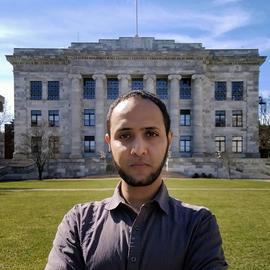
About Me
I am a researcher working on physics-exact machine learning for medical imaging. Image reconstruction and analysis are inverse problems governed by known physical laws, yet most learned methods treat that physics merely as a soft prior. My research builds architectures where physical acquisition laws operate as immutable constraints within the network itself. Clinical adoption demands machine learning that is strictly free from hallucinations, and embedding exact physics is how we bridge the gap between deep learning and trusted diagnostic tools.
Beyond research, I care a lot about helping more students access higher education through The College Grind, where I share practical, honest advice on choosing a college, paying for it, and getting through it.
Reach out if you want to collaborate, have a question, or could use some advice.
Publications
Experience

- Developing a reinforcement learning method, driven by an MRI physics simulator, to discover MR Fingerprinting sequences for ultra-low-field portable MRI. Hand-designed clinical schedules don’t transfer to this regime.
- Building a lung parenchyma segmentation model trained entirely on synthetic anatomical data. This sidesteps the ground-truth bottleneck, since parenchyma is hard to distinguish visually from pulmonary vasculature.
- Developing a cardiac MRI segmentation model trained exclusively on synthetic images with randomized contrast and resolution. This makes it robust to the contrast variability across cardiac protocols.

- Created MyoMapNet, a physics-informed network that cut cardiac T1 mapping from 17 heartbeats to 4, or 2 minutes to under 12 seconds. Validated in a multi-center study, deployed inline via Siemens OpenRecon, and open-sourced.
- Built DRAPR, a 3D U-Net for 12x-accelerated real-time cardiac cine under stress. Enforcing data consistency against raw multi-coil k-space fixed a failure where image-domain training suppressed real motion.
- Developed REGAIN, a resolution-enhancement GAN for cardiac cine. Training through the scanner’s own parallel-imaging pipeline closed the simulation-to-real gap, enabling 13.6- to 16-fold effective acceleration.

- Invented a contactless mmWave sensor that records a seismocardiogram without a contact accelerometer. A differential filter separates periodic cardiac motion from aperiodic body motion.
- Built a C++/Boost pipeline for real-time, concurrent multi-sensor acquisition. Used MATLAB to analyze the cardiac signal for markers of atrial fibrillation and ischemia.
- Published as co-first author at ACM MobiCom 2020, a flagship mobile systems venue. The work became my master’s thesis on contactless cardiovascular monitoring with mmWaves.

- Independently designed an abstractive text-summarization tool (bidirectional LSTM with attention) after finding that no existing tool met requirements. Built in TensorFlow, NumPy, and Pandas and evaluated with Pyrouge.
- Architected a scalable, distributed data lake on AWS using Hadoop and Hive. It gave the team a foundation for storing and querying large datasets.
- Served as a full-stack developer on a scrum team, building with C# and JavaScript frameworks including AngularJS & Backbone. Delivered features end to end within sprint cycles.

- Designed a privacy-preserving doorway sensor using a binocular thermal camera, classifying direction of travel with 99.7% accuracy. Images are processed on-device, so no identifiable data is transmitted.
- Built a physics-grounded synthetic-data pipeline that renders thermal images from Planckian blackbody radiance and tissue emissivity. Standard augmentation failed to preserve the fidelity needed to generalize to real captures.
- Rewrote the camera driver in branchless C and designed an optical flow algorithm using just 33 bytes of working memory on an 8-bit ATtiny. Throughput rose 3000% while energy use fell 50%.
Contact
- sassana@mgh.harvard.edu
- 617 724 0225
- 149 13th St, Charlestown, MA 02129
- Athinoula A. Martinos Center for Biomedical Imaging
- Friday 17:00 to 18:00
- Book an appointment
- DM Me